



Small Skipper (Thymelicus sylvestris)

Sandwich Bay, Kent

Martin Down NNR, Dorset
A common species of grassy habitats, the Small Skipper flies from early June until the end of summer. It is found across England and Wales but is absent from most of Scotland.
The Small Skipper is very similar to the Essex Skipper, which has black undersides to the antennae tips - those of the Small Skipper are orange.
The Small Skipper is very similar to the Essex Skipper, which has black undersides to the antennae tips - those of the Small Skipper are orange.
Lulworth Skipper (Thymelicus acteon)
Image coming soon!
Text coming soon!
Silver-Spotted Skipper (Hesperia comma)

Fontmell Down NR, Dorset
In mainland Europe, this is a common species but in Britain it is a rarity, restricted to warm, chalk grassland in southern England. As its name suggests, the silver spots on the underwings are very distinctive and make thos species easy to identify, if you are lucky enough to see it.
The Silver-spotted Skipper has a short flight period, emerging in August and disapperaing again by early September.
The Silver-spotted Skipper has a short flight period, emerging in August and disapperaing again by early September.
Large Skipper (Ochlodes sylvanus)


Glapthorn Cow Pasture NR, Northamptonshire

male, Coombs Dale SSSI, Derbyshire
With a similar range to the Small Skipper, this is probably Britain's most common member of the genus. Despite its name, it is a similar size to most of our other skippers, being only very slightly larger in many cases.
The best identification features for this species is its faintly-chequered pattern, seen on both sides of the wings. The most similar species (Small & Essex Skippers) lack this pattern and also emerge a little later in the summer than the Large Skipper.
The best identification features for this species is its faintly-chequered pattern, seen on both sides of the wings. The most similar species (Small & Essex Skippers) lack this pattern and also emerge a little later in the summer than the Large Skipper.
Chequered Skipper (Carterocephalus palaemon)

Glasdrum Wood, Argyll, Scotland
Along with the Lulworth Skipper, this is Britain's rarest member of the family, restricted to oak woodland on the west coast of Scotland, and recently reintroduced to the English Midlands, where it became extinct in 1976.
It's not a great photo, as the individual shown was rather worn, but the bold, chequered pattern makes this fast-flying species unmistakable. It flies in late spring and early summer, disappearing by the end of June (in Scotland, at least).
It's not a great photo, as the individual shown was rather worn, but the bold, chequered pattern makes this fast-flying species unmistakable. It flies in late spring and early summer, disappearing by the end of June (in Scotland, at least).
Grizzled Skipper (Pyrgus malvae)


mating pair, Martin Down NNR, Dorset
Britain's only member of the large genus Pyrgus, which includes many similar species across southern Europe, the Grizzled Skipper is at the edge of its range here in Britain, where it occurs in the southern half of England, often on chalk downland. Other sunny habitats are also enjoyed by this lovely species, including brownfield sites.
Like other species, it is slowly extending its range northwards and can now be found on the southern border of Derbyshire - an unthinkable scenario twenty or thirty years ago.
Like other species, it is slowly extending its range northwards and can now be found on the southern border of Derbyshire - an unthinkable scenario twenty or thirty years ago.
Dingy Skipper (Erynnis tages)


Coombs Dale SSSI, Derbyshire

Martin Down NNR, Dorset
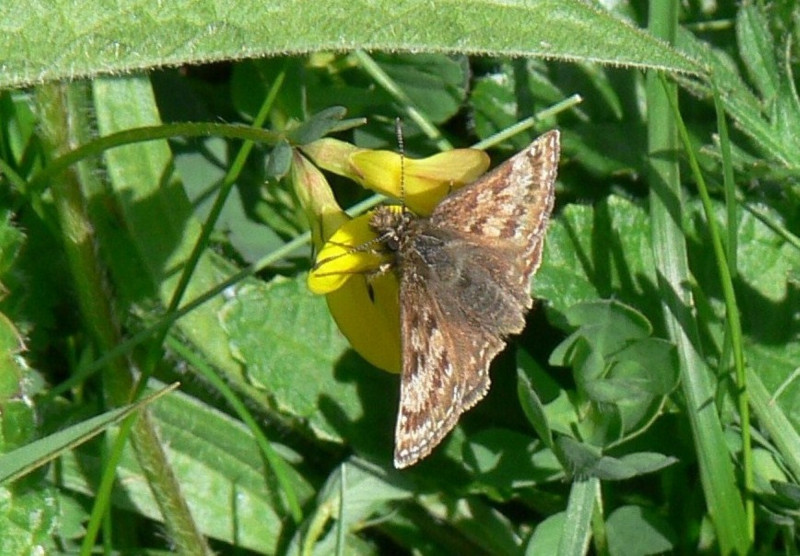
The limestone dales of the Peak District are a local stronghold of this drably-coloured butterfly. Like the Grizzled Skipper, it is a species of sunny habitats, where it often basks on bare soil or exposed stones on the ground. In flight this species looks almost moth-like, but when settled, its true identity is easily seen.

Rose End Meadows NR, Derbyshire
Rose End Meadows NR, Derbyshire
Green Hairstreak (Callophrys rubi)

Howe Ridding Wood NR, Cumbria


Coombs Dale SSSI, Derbyshire (this and previous photo)

Martin Down NNR, Dorset

Cressbrook Dale NNR, Derbyshire
Britain's most widespread hairstreak, this attractive species can be easily overlooked and often catches the eye as a shimmering, iridescent movement near scrubby vegetation.
It is very easy to recognise - no other British butterfly is bright green. It never rests with its wings open, so the brown uppersides are only seen in flight.
The Green Hairstreak emerges in early May and is often seen perching in sunny clearings on branches or bushes - I've never seen this species on the ground.
It is very easy to recognise - no other British butterfly is bright green. It never rests with its wings open, so the brown uppersides are only seen in flight.
The Green Hairstreak emerges in early May and is often seen perching in sunny clearings on branches or bushes - I've never seen this species on the ground.
Brown Hairstreak (Thecla betulae)


Whitecross Green Wood, Oxfordshire
This attractive, understated species is one of our most threatened species due to historical destruction of its favoured hedgerow habitats.
The Brown Hairstreak is a late flyer, emerging in August. Its brown and orange upperwings and typical hairsteak underwings make it easy to identify. Its larvae feed on Blackthorn, and its favoured sites are in mature woodland which contain both its foodplant and tall trees where males can maintain territories. Like our other hairstreaks, the chrysalis is dependent upon ants for safety (the only exception being the White-letter Hairstreak).
The Brown Hairstreak is a late flyer, emerging in August. Its brown and orange upperwings and typical hairsteak underwings make it easy to identify. Its larvae feed on Blackthorn, and its favoured sites are in mature woodland which contain both its foodplant and tall trees where males can maintain territories. Like our other hairstreaks, the chrysalis is dependent upon ants for safety (the only exception being the White-letter Hairstreak).
Black Hairstreak (Satyrium pruni)


Glapthorn Cow Pasture NR, Northamptonshire
Even rarer and more threatened than the Brown Hairstreak, this beautiful species is restricted to the Midlands, where it is found in scattered sites in scrubby woodland where Blackthorn grows abundantly. Most of its remaining sites are nature reserves, carefully managed to ensure its survival.
This species looks very similar to the White-letter Hairstreak - the best feature to identify it is the row of spots between the orange band and white lines on the underwings - these are bold and have white inner edges. The White-letter Hairstreak has a wiggly black line instead.
This species looks very similar to the White-letter Hairstreak - the best feature to identify it is the row of spots between the orange band and white lines on the underwings - these are bold and have white inner edges. The White-letter Hairstreak has a wiggly black line instead.