



Picea abies (Norway Spruce)


Le Boreon
The only spruce species native to France, P.abies is a tall tree that is often common in montane forests.
It can be distinguished from similar conifer species by its 4-sided (rather than flat) leaves and fallen twigs which have peg-like projections where the leaves have become detached.
When present, the long, cylindrical cones are pendent rather than erect.
It can be distinguished from similar conifer species by its 4-sided (rather than flat) leaves and fallen twigs which have peg-like projections where the leaves have become detached.
When present, the long, cylindrical cones are pendent rather than erect.
Larix decidua (Larch)


A dominant tree of montane forests in the Alps, the larch is a beautiful, graceful conifer, with bunchs of short needles. It is deciduous, with leaves (and whole mountainsides) turning golden yellow in autumn before the leaves fall.

Pinus cembra (Arolla Pine)


Le Boreon
A robust, bushy pine of montane woodlands througout the French Alps, P.cembra is easy to recognise, as it has blue-green leaves in bunches of five, which gives the branches as much fuller aspect to the eye than other French pine species.
When present, the cones are distinctly purplish in colour.
When present, the cones are distinctly purplish in colour.
Alnus viridis (Green Alder)

The smallest of Europe's alders, Green Alder grows as a dense shrub, sometimes forming thickets in forest margins and open pastures. As its name suggests, the leaves are bright green and have a round profile with pointed tips.
Salix reticulata (Net-leaved Willow)

While a very rare plant in the British mountains, S.reticulata is much more common in the Alps, where it grows in damp rock fissures and among scree.
You can see photos of it growing in Scotland here.

You can see photos of it growing in Scotland here.
Lychnis flos-jovis
The only Lychnis found high in the French Alps (other species are now included in Silene), L.flos-jovis is a beautiful plant of rocky, acidic meadows at subalpine elevations. Its bold pink flowers and silvery-hairy foliage make is easy to recognise.


Col de Tende

Val Gordolasque, Mercantour PN
Silene acaulis (Moss Campion)

Col de Tende
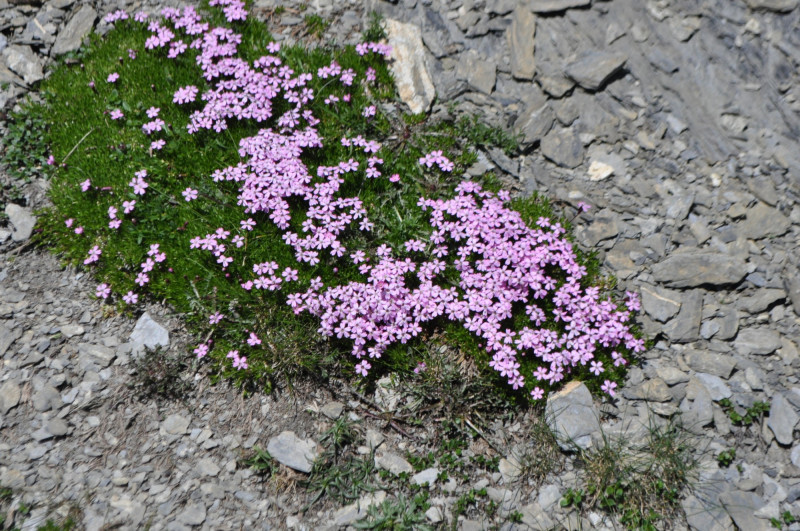
This lovely cushion-forming alpine is common in the French Alps in calcareous areas.
I've described it in more detail in the Flora of Ben Lawers NNR section of the site.
I've described it in more detail in the Flora of Ben Lawers NNR section of the site.
Silene nutans


Le Boreon
A delicate species of warm, dry habitats, S.nutans is widespread in all of France, ascending to lower alpine elevations. This population was growing in a woodland clearing low in the mountains.
You can see photos of S.nutans growing in England here.
You can see photos of S.nutans growing in England here.
Dianthus pavonius


foliage detail
One of the commonest Dianthus species encountered in alpine meadows in the French Alps, D. pavonius is easy to recognise by its three-veined leaves and long epicalyx scales. Its petals are also tan-coloured on the reverse.
D. pavonius inhabits acidic terrain and is unlikely to be confused with other French Dianthus species, which are generally much taller plants.

Le Boreon, Mercantour PN
D. pavonius inhabits acidic terrain and is unlikely to be confused with other French Dianthus species, which are generally much taller plants.
Le Boreon, Mercantour PN
Minuartia sedoides

Le Boreon
A widespread plant of acidic alpine meadows, M.sedoides is a frequent sight in the mountains. You can see photos of M.sedoides from Britain (where it is much rarer) here.
Minuartia rupestris ssp. rupestris


foliage detail, Col de la Bonette, Mercantour PN (both photos)

Arenaria grandiflora


Col de Tende
A handsome plant, which is not done any justice by my photo (!), A.grandiflora is well-named, for it has a very large flower for the size of the foliage. It is a plant of calcareous scree and other rocky places, identified by its long pedicel and solitary flowers. The leaves have a thickened, rough margin when examined closely.
Anemone narcissiflora

Val Gordolasque, Mercantour PN

Col de Tende
Of the two alpine anemones found in the French Alps, this is my favourite. Its flowers do indeed resemble those of Narcissus poeticus and its relatives.
It is a plant of calcareous terrain and is easy to distinguish from its widespread cousin, A.baldensis, because it has several flowers on each flowering stem.
Although more widespread in Europe than baldensis, I find this species to be much the less common of the two in the French Alps. It occurs in all mountainous regions of France.
It is a plant of calcareous terrain and is easy to distinguish from its widespread cousin, A.baldensis, because it has several flowers on each flowering stem.
Although more widespread in Europe than baldensis, I find this species to be much the less common of the two in the French Alps. It occurs in all mountainous regions of France.
Anemone baldensis


Val Gordolasque, Mercantour PN
This anemone is also a resident of calcareous scree and rocky meadows, but looks quite different from A.narcissiflora. It has a more typical anemone flower with seven overlapping petals and much more finely-divided, delicate foliage.
In France, this species is confined to the Alps.
In France, this species is confined to the Alps.
Hepatica nobilis

Instantly recognisable by its three-lobed leaves, Hepatica is a widespread plant in Europe, often growing in dappled shade on the forest floor. It flowers very early in the year, so I've never been lucky enough to see it in bloom in my travels.

Ranunculus aconitifolius

Val Gordolasque, Mercantour PN

leaf detail, Le Boreon
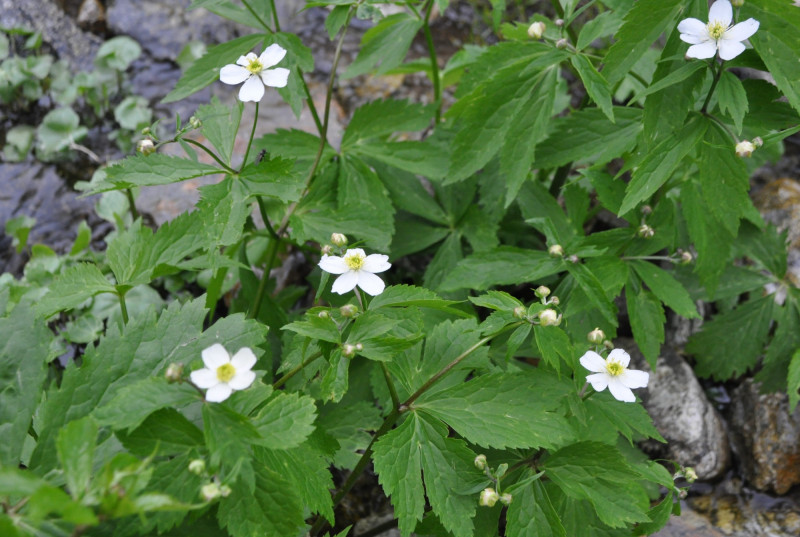
The distinctively-shaped leaves make this fairly tall, white-flowered buttercup easy to recognise. It is a plant of damp habitats and can be found in all mountainous regions of France.
The very similar R.platanifolius also occurs in the Alps but has the leaf segments fused together for a short distance above the petiole, so the leaves look like those of a sycamore (hence the name), rather than an aconite.
The very similar R.platanifolius also occurs in the Alps but has the leaf segments fused together for a short distance above the petiole, so the leaves look like those of a sycamore (hence the name), rather than an aconite.
Ranunculus montanus (probably)


Val Gordolasque, Mercantour PN
A low-growing buttercup of alpine meadows and rocky pastures R. montanus is a member of a difficult species aggregate. These species are very similar and a good view of the leaves is essential for determining which taxon is present. R. montanus is distinguished from R. carinthiacus by having some hairs on the leaves and stems leaves which slightly clasp the stem. Its flowers are slightly larger as well.
This species is widespread in the French Alps, as well as the Jura Mountains and Pyrenees.

This species is widespread in the French Alps, as well as the Jura Mountains and Pyrenees.
Thalictrum aquilegiifolium ssp.aquilegiifolium


Val Gordolasque, Mercantour PN
A stunning plant of damp alpine pastures, this Thalictrum makes a very impressive sight when a large colony is found.
As a species, it is easily recognised and well-named - the foliage does look exactly like that of an Aquilegia. The white pom-pom flowers also look much more impressive than other members of the genus found in the Alps.

As a species, it is easily recognised and well-named - the foliage does look exactly like that of an Aquilegia. The white pom-pom flowers also look much more impressive than other members of the genus found in the Alps.
Thalictrum alpinum

near Col de la Bonette, Mercantour PN
This widespread perennial of flushed mountain slopes is described in the Flora of Ben Lawers NNR section of the site.
Cardamine resedifolia


Val Gordolasque, Mercantour PN
One of several alpine Cardamine species, C. resedifolia is the most widespread in France. It can be recognised by its spoon-shaped, unlobed lower leaves and the upper leaves divided into simple lobes. The most similar species, C. plumieri has more divided leaves which resemble ivy.
C. resedifolia is a plant of siliceous habitats, either in meadows or on scree.
C. resedifolia is a plant of siliceous habitats, either in meadows or on scree.
Brassica repanda


Val Gordolasque, Mercantour PN
This lovely relative of the humble cabbage is a speciality of the French Alps.
It can be distinguished from other small yellow-flowered crucifers by having only basal leaves. These are long and slightly spoon-shaped, with serrated margins.
It can be distinguished from other small yellow-flowered crucifers by having only basal leaves. These are long and slightly spoon-shaped, with serrated margins.
Biscutella laevigata


Col de Tende
Text coming soon!

Le Boreon, Mercantour PN
Le Boreon, Mercantour PN
Noccaea rotundifolia

Col de la Bonette, Mercantour PN
Formerly known as Thlaspi rotundifolium, this very distinctive plant is a resident of calcareous scree. Even when not in flower (as here), the dense rosettes of almost rubbery, dark green leaves make it easy to recognise.
When present (in spring), the flowers are bright pink-purple and pleasantly scented.

fruits
When present (in spring), the flowers are bright pink-purple and pleasantly scented.
fruits
Arabis alpina

Col de la Bonette, Mercantour PN

Sempervivum arachnoideum

Val Gordolasque, Mercantour PN

Le Boreon
This common species of acidic rocks is described in the Flora of the Cordillera Cantabrica section of the site.

rosette detail, Le Boreon

Col de Tende
rosette detail, Le Boreon
Col de Tende
Sempervivum montanum


Le Boreon
Sempervivum montanum is described in the Flora of the Queyras - part 1 section of the site.

in habitat
in habitat
Sempervivum tectorum

Col de Tende
This robust Sempervivum is described in the Flora of the Queyras section of the site.
Hylotelephium anacampseros

Val Gordolasque, Mercantour PN
This species is described in the Flora of the Queyras - part 1 section of the site.
Sedum album

Col de Tende

Rhodiola rosea


This widespread plant of rocky area in the mountains is always a joy to see. It can form quite large clumps, and its size alone makes it easy to recognise - all other French Sedums and relatives are much smaller apart from S.telephium, which is a woodland plant of lower altitudes.
You can see photos of R.rosea from Britain here.
You can see photos of R.rosea from Britain here.
Saxifraga retusa

Le Boreon
This species is described in the Flora of the Queyras - part 1 section of the site.
Saxifraga androsacea


Col de la Bonette, Mercantour PN

Saxifraga oppositifolia

Col de Tende
This common alpine species is described in the Flora of Ben Lawers NNR section of the site.

Val Gordolasque, Mercantour PN
Val Gordolasque, Mercantour PN
Saxifraga paniculata

Le Boreon
This common species is described in the Flora of the Cordillera Cantabrica - part 1 section of the site.

Col de la Bonette, Mercantour PN
Col de la Bonette, Mercantour PN
Saxifraga diapensioides


Col de Tende
One of the restricted-range saxifrages of the south-western Alps, S. diapensioides is a gem of a plant and always a lovely surprise to encounter. It is restricted to strongly calcareous, shady, dry rock ledges.
Its small, highly-encrusted, densely-packed, leaves (with easily-visible lime glands inside the margins) and large white flowers make it easy to recognise. No similar species occur within its range, which is along the French-Italian border from the Col de Tende (photographed here) to Savoie in the north.

Its small, highly-encrusted, densely-packed, leaves (with easily-visible lime glands inside the margins) and large white flowers make it easy to recognise. No similar species occur within its range, which is along the French-Italian border from the Col de Tende (photographed here) to Savoie in the north.
Saxifraga callosa


Col de Tende
S. callosa is an impressively-sized species with beautiful, tall white flower spikes which create a stunning impact when seen en-masse. Unlike the previous species, it has long, linear leaves which grow in loose, irregular rosettes. In the Maritime Alps, the slightly similar S. cochlearis can be found but this species is smaller in all respects and has hairy flowering stems.
S. callosa is a rare plant in France (totally confined to the Maritime Alps), at the north-western limit of its distribution - it is widespread in Italy, with a disjunct subspecies found in Spain.

S. callosa is a rare plant in France (totally confined to the Maritime Alps), at the north-western limit of its distribution - it is widespread in Italy, with a disjunct subspecies found in Spain.
Saxifraga stellaris

Val Gordolasque, Mercantour PN

Saxifraga florulenta


Mercantour PN, Alpes-Maritimes
Perhaps, the classic alpine plant of the Maritime Alps, this extremely localised and strictly-protected species was wonderful to see. Like S. longifolia, it is a monocarpic species, with a similar aspect - a broad rosette of leaves and a towering flower spike. Like its cousin, it grows on vertical crags, ekeing out a living in cracks in otherwise barren siliceous rock.
I am very grateful to our wonderful French hosts for pointing me in the right direction to photograph these precious plants.

I am very grateful to our wonderful French hosts for pointing me in the right direction to photograph these precious plants.
Saxifraga bryoides

Le Boreon
Although similar to S. aspera, this common saxifrage has incurved leaves - those of S. aspera stick straight out from the stems.
S. bryoides has a wide distribution, being found in most mountainous regions of mainland Europe, from the Pyrenees to the Carpathians in the east.
S. bryoides has a wide distribution, being found in most mountainous regions of mainland Europe, from the Pyrenees to the Carpathians in the east.
Saxifraga exarata ssp.exarata


Le Boreon
Text coming soon!


Col de la Bonette, Mercantour PN
Col de la Bonette, Mercantour PN
Dryas octopetala (Mountain Avens)


Col de Tende
This beautiful species is common in calcareous alpine meadows in France, where it is easily recognised by its oak-like leaves and eight-petalled flowers.
Mountain Avens is described in more detail in the Flora of Scotland section of the site.

Mountain Avens is described in more detail in the Flora of Scotland section of the site.
Potentilla aurea


Col de la Bonette, Mercantour PN
Probably the most common Potentilla species in the Alps, P.aurea is a mat-forming plant rather than a tall-growing species.
Its most distinctive identifying feature is the small tooth that terminates each leaflet, which is much shorter than the other teeth along the edges. This gives the leaflets a rather flat-topped look.
Its most distinctive identifying feature is the small tooth that terminates each leaflet, which is much shorter than the other teeth along the edges. This gives the leaflets a rather flat-topped look.
Potentilla sp


Le Boreon
Text coming soon, pending identification!
Potentilla valderia


Col de Tende
Endemic to the Maritime Alps, this slightly drab Potentilla is nonetheless a special plant to have seen. It is very distinctive, having ashy-grey serrated foliage and a vigorous, bushy habit. In some ways it resembles P. nivalis, but that species is absent from the Alps.
Helianthemum oelandicum ssp. alpestre

Col de Tende
Text coming soon.

Linaria alpina

Col de Tende
This sun-loving scree species is described in the Flora of the Cordillera Cantabrica - part 1 section of the site.
Astragalus sempervirens


Col de la Bonette
Although superficially similar to several other pale purple Astragalus species, any close encounter with A.sempervirens will reveal how spiny it is! This feature is unique among European members of the genus, in addition to its flower spikes which remain embedded among the leaves.
A.sempervirens grows as a low, sprawling shrubby perennial in exposed, dry habitats. It can be found in warmer parts of the French Alps, as well as the Apennines in Italy and the eastern Pyrenees (you can see a photo of a Pyrenean plant in Spain here).

A.sempervirens grows as a low, sprawling shrubby perennial in exposed, dry habitats. It can be found in warmer parts of the French Alps, as well as the Apennines in Italy and the eastern Pyrenees (you can see a photo of a Pyrenean plant in Spain here).
Astragalus alpinus


Col de la Bonette, Mercantour PN
Text coming soon.
Oxytropis neglecta


Col de Tende
This lovely plant is a speciality of the Maritime Alps - the only place in the French Alps that this plant occurs. Even here it is not common, and is most frequent in the south-east, such as around Tende, where it grows in hot, dry limestone terrain. It is much more common in the Pyrenees.
O. neglecta is fairly easy to recognise by its sprawling habit, moderately (but not densely) hairy foliage and bright purple flowers.

O. neglecta is fairly easy to recognise by its sprawling habit, moderately (but not densely) hairy foliage and bright purple flowers.
Oxytropis helvetica


Col de la Bonette, Mercantour PN
Text coming soon.

Hedysarum boutignyanum

Col des Champs
A lovely plant of calcareous mountain pastures, Hedysarum is easy to recognise when its tall, one-sided pale pink flower spikes are present.
The two other species recognised in the French Alps, H. hedysaroides and H. brigantiacum both have purple flower spikes. H. hedysaroides also has acute tips to the upper leaves - the other two have rounded, retuse leaf tips.

The two other species recognised in the French Alps, H. hedysaroides and H. brigantiacum both have purple flower spikes. H. hedysaroides also has acute tips to the upper leaves - the other two have rounded, retuse leaf tips.
Trifolium alpinum

Val Gordolasque, Mercantour PN
This common plant of acidic pastures is described in the Flora of the Pyrenees - part 1 section of the site.

Anthyllis montana

Col de Tende
Easily recognised by its clustered purple flower heads, A.montana is found throughout the mountains of southern Europe in dry, calcareous terrain. Unlike A.vulneraria, it grows as a dwarf shrub rather than a perennial and is densely hairy.

Geranium sylvaticum (Wood Cranesbill)

Col de Tende
This species is described in the Flora of the Queyras - part 2 section of the site.
Daphne mezereum

Val Gordolasque, Mercantour PN
Text coming soon.

Plantago alpina


Col de la Bonette, Mercantour PN
As its name suggests, this is a high-altitude plantain, and the only member of the family to occur at genuine alpine elevations in the French Alps.
Its rather drab, spindly flowerheads are instantly recognisable as plantains. The leaves of this species are linear and rather greyish-green, somewhat resembling a Dianthus. The whole plant is small and little more than 10cm tall when flowering.
P.alpina is a plant of relatively dry, rocky habitats, often where snow lies late in the year. It occurs in all mountainous parts of France.
Its rather drab, spindly flowerheads are instantly recognisable as plantains. The leaves of this species are linear and rather greyish-green, somewhat resembling a Dianthus. The whole plant is small and little more than 10cm tall when flowering.
P.alpina is a plant of relatively dry, rocky habitats, often where snow lies late in the year. It occurs in all mountainous parts of France.
Rhamnus pumilus

Col de Tende
Text coming soon.

Valeriana montana

Col de Bonette, Mercantour PN


Col de Tende
Text coming soon.

leaf detail, Col de Bonette
leaf detail, Col de Bonette
Noccaea corymbosa

Le Boreon
This attractive species is confined to two separate areas in the French Alps - the Maritime Alps and Savoie. In both these areas, it occurs in rock habitats on siliceous soils and avoids calcareous sites.
In many respects, this species is similar to N. rotundifolia, but has paler pink flowers and more sessile leaves.
Thanks to Thomas Legland for the ID.

foliage detail
In many respects, this species is similar to N. rotundifolia, but has paler pink flowers and more sessile leaves.
Thanks to Thomas Legland for the ID.
foliage detail
Silene cordifolia

Val Gordolasque, Mercantour PN
This special plant is endemic to the Maritime Alps. The flowers resemble other Silene species, although they are often borne singly and have very deeply-notched petals. The leaves are characteristically heart-shaped and clasp the stems. S. cordifolia grows in scree habitats and rocky meadows.

foliage detail
foliage detail
Saxifraga cuneifolia

Le Boreon, Mercantour PN
Text coming soon.

Geum montanum

Le Boreon, Mercantour PN
Text coming soon.


seedhead, Col de Tende
seedhead, Col de Tende
Draba dubia

Col de Bonette, Mercantour PN
Text coming soon.
Galium obliquum


Val Gordolasque, Mercantour PN
Text coming soon.
Thanks to Thomas Legland for the ID.
Thanks to Thomas Legland for the ID.
Galium pseudohelveticum


Col de Bonette, Mercantour PN
Text coming soon.
Thanks to Thomas Legland for confirming the ID.
Thanks to Thomas Legland for confirming the ID.
Galium tendae


Val Gordolasque, Mercantour PN
Text coming soon.
Thanks to Thomas Legland for the ID.
Thanks to Thomas Legland for the ID.