



Luzula sudetica


Col du Galibier, Savoie
Similar to the very common L.campestris, this species is also widespread across mountainous areas of Europe.
Apart from the bright yellow anthers of the flowers of L.campestris, the two species are most easily distinguished by the tepals surrounding the fruits later in the year - those in L.campestris are all of equal length, while those of sudetica are unequal. L.campestris is also a plant of dry, calcareous habitats, whereas L.sudetica is a calcifuge of damp, peaty places.
Apart from the bright yellow anthers of the flowers of L.campestris, the two species are most easily distinguished by the tepals surrounding the fruits later in the year - those in L.campestris are all of equal length, while those of sudetica are unequal. L.campestris is also a plant of dry, calcareous habitats, whereas L.sudetica is a calcifuge of damp, peaty places.
Carex atrata


Carex bicolor


track to Refuge de Carro, Vanoise PN, Savoie
One of the special sedges of the Alps, C.bicolor is a rare speciesand one I was delighted to find here in Savoie, having missed it at one of its few localities in the Queyras (the area is cordoned off with access prohibited as a conservation area).
This sedge is aptly-named, with conspicuous pale green and dark brown utricles on the fruiting spikes, similar in some ways to C.nigra, but the plants are very different in appearance. It is a small sedge (up to around 10cm tall) with a rather floppy or procumbent growth habit. It grows in damp, calcareous flushed or marshy habitats in the Alps
This sedge is aptly-named, with conspicuous pale green and dark brown utricles on the fruiting spikes, similar in some ways to C.nigra, but the plants are very different in appearance. It is a small sedge (up to around 10cm tall) with a rather floppy or procumbent growth habit. It grows in damp, calcareous flushed or marshy habitats in the Alps
Carex parviflora


Vanoise PN
This commonly-seen alpine sedge is closely related to C.atrata (indeed, in older references it was regarded as a subspecies of C.atrata), but differs in being smaller in all its parts.
In the French Alps, at least, the two species occupy different habitats - C.atrata is a species of moist, acidic habitats (although in Britain it is a strong calcicole), whereas C.parviflora is a plant of dry, calcareous terrain.

In the French Alps, at least, the two species occupy different habitats - C.atrata is a species of moist, acidic habitats (although in Britain it is a strong calcicole), whereas C.parviflora is a plant of dry, calcareous terrain.

Carex ferruginea (probably)


N side of Col du Galibier, Savoie
Thank you to Thomas Legland for the identificaton.
Text coming soon!
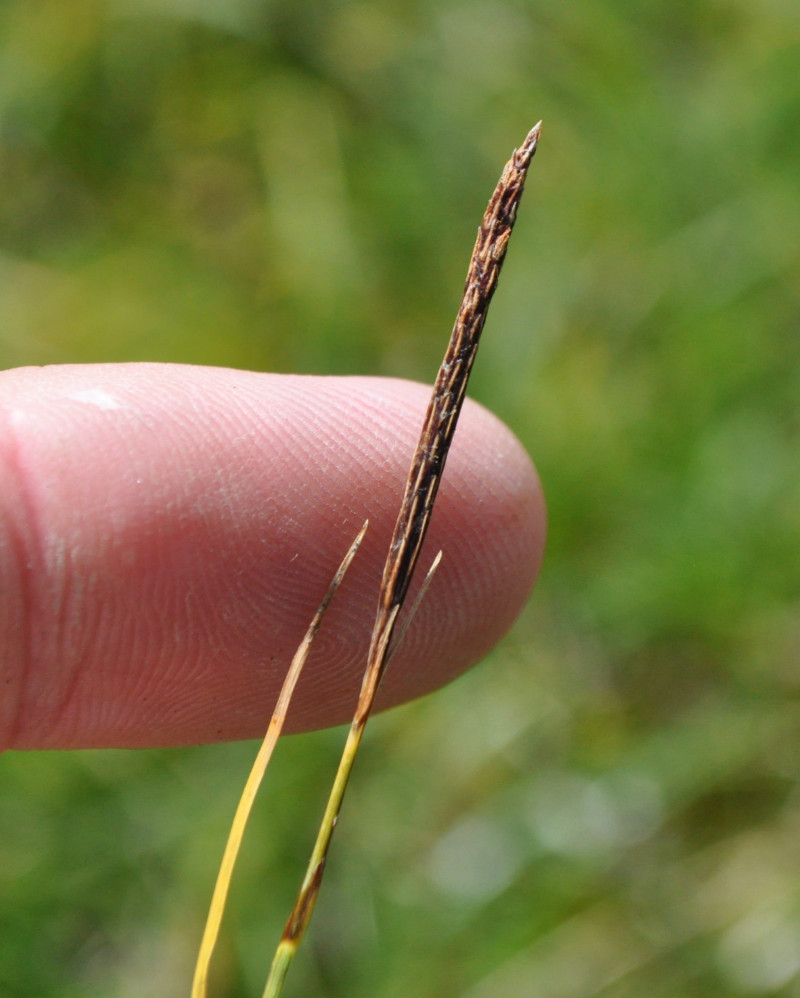
Text coming soon!
Carex davalliana

One of only two dioicous sedges in the French Alps, C.davalliana is a common species and easily identified by its tufted habit. The other species, C.dioica is found as scattered shoots and is a much less obvious plant when seen. C.dioica also occurs at lower altitudes in France, below 2000m.

Carex curvula


As its name suggests, the flowering spikes of this sedge are distinctively curved. It is a medium-sized sedge (around 30cm tall) of dry, often cold habitats such as ridges and summiit crests. On close inspection, it has keeled utricles. Two subspecies are recognised: ssp.curvula, which has thin leaves and is a plant of acidic soils, and ssp.rosae, which has thicker leaves and is restricted to calcareous habitats.
The most similar species is C.bipartita (syn.Kobresia simpliciuscula), which is a very rare plant of the Vanoise and has utricles with rounded, non-keeled backs.

fruiting spike detail
The most similar species is C.bipartita (syn.Kobresia simpliciuscula), which is a very rare plant of the Vanoise and has utricles with rounded, non-keeled backs.
fruiting spike detail
Carex frigida


Carex foetida

PN Ecrins, Hautes-Alpes

track to Carro Refuge, Vanoise PN, Savoie

Kobresia myosuroides

path to Carro Refuge, Vanoise PN
Text coming soon.
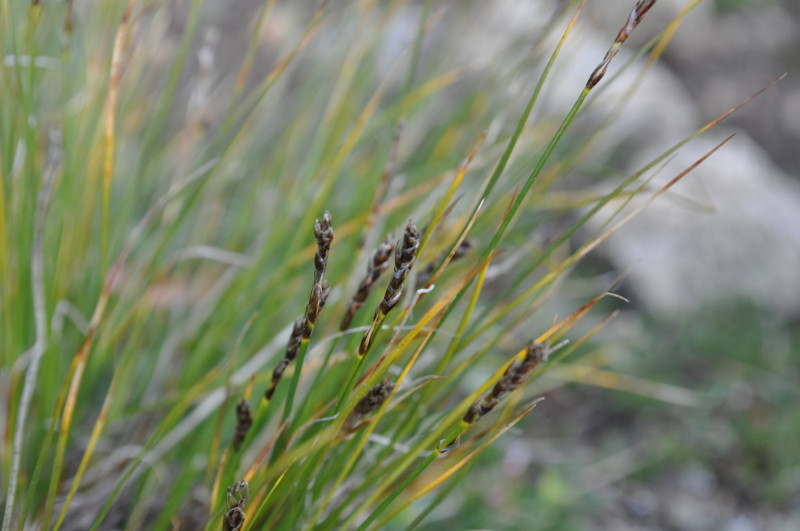
Juncus castaneus

path to Carro Refuge, Vanoise PN
This species is described in the Flora of Ben Lawers NNR - Sedges & Rushes section of the site.
Juncus trifidus

path to Carro Refuge, Vanoise PN
Text coming soon.

Luzula alpinopilosa


Refuge Etendard, Savoie
Text coming soon.
Luzula sp

path to Refuge Etendard, Savoie
Text coming soon.

Stipa pennata ssp.pennata


Ecrins PN, Hautes-Alpes
The only Stipa species to occur at high altitude in the Alps, S.pennata is easy to distinguish from other grasses when in flower, thanks to its long plume-like flower spikes.
It inhabits hot, dry niches on calcareous rocks in the Alps (and is also a very rare plant in Alsace). The plants photographed here were on a south-facing schist crag above the Glacier Noir in Ecrins.
It inhabits hot, dry niches on calcareous rocks in the Alps (and is also a very rare plant in Alsace). The plants photographed here were on a south-facing schist crag above the Glacier Noir in Ecrins.
Festuca acuminata


path to Refuge de Carro, Vanoise PN, Savoie
Text coming soon!
Thanks to Thomas Legland for the identification.

Thanks to Thomas Legland for the identification.
Grass sp

Text coming soon!

Poa alpina var. vivipara

path to Refuge de Carro, Vanoise PN, Savoie

Col du Galibier
Text coming soon!

Carro

Col du Galibier
Carro
Col du Galibier
Phleum alpinum (Alpine Timothy)

Col du Galibier (N side), Savoie
Text coming soon!

Huperzia selago (Fir Clubmoss)


Text coming soon!
Asplenium septentrionale (Forked Spleenwort)


Selaginella selaginoides

N side of Col du Galibier, Savoie
This species is described in the Flora of the Queyras section of the site.
Botrychium lunaria (Moonwort)

path to Refuge de Carro, Vanoise PN

Eriophorum angustifolium

Col du Galibier
Text coming soon!
Eriophorum sp

Col du Galibier
Text coming soon!
